DFM Mimir release note
Today, Danish Foundation Models releases Mimir v1, a 1-billion-parameter HRM language model (HRM-Text), trained from scratch using the HRM-Text framework. Mimir v1 is optimised for Danish and English tasks and trained exclusively on permissible and openly licensed data, in line with the DFM philosophy.
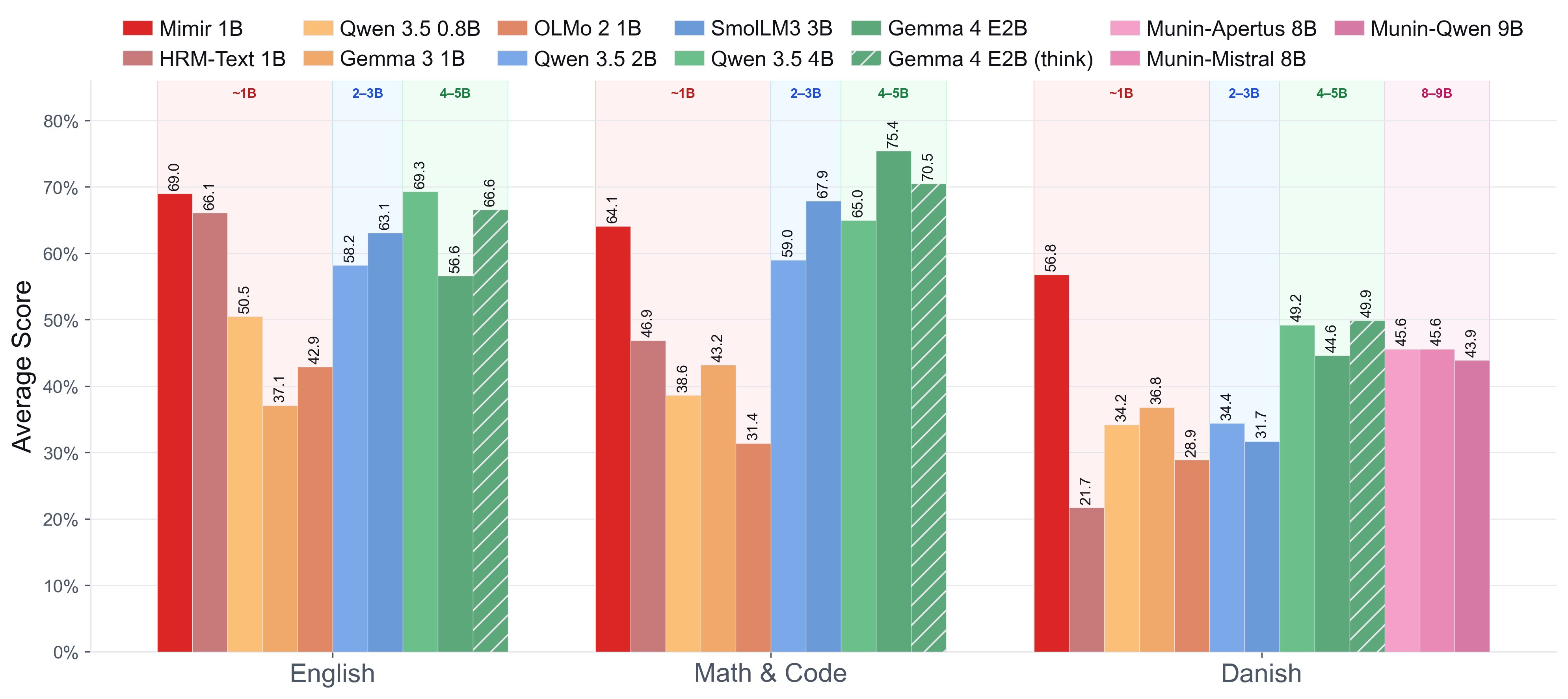
Comparing DFM Mimir against the original HRM-Text, Qwen 3.5 2B, and Gemma 4 E2B, demonstrating strong performance across a broad set of benchmarks.
Why Mimir?
Current large language model development relies on massive, often non-permissible datasets, creating a high barrier for researchers committed to open source and ethically sourced data. We introduce Mimir v1, a 1-billion-parameter language model based on the Hierarchical Reasoning Model (HRM) architecture, which is trained from scratch and delivers highly competitive performance in English while setting a new state of the art for Danish using only permissible post-training data. Trained on a mixture of 161 datasets, Mimir outperforms the original HRM-Text 1B and competes with larger frontier models such as Qwen 3.5 4B and Gemma 4 E2B, tested across 20 benchmarks for English, Math & Code, and Danish.
Technical Report
Mimir provides strong capabilities in both the Danish and English domains. See all results in the technical report here, and find the model on the Hugging Face Hub here.
Contributors
We list contributions according to the Contributor Roles Taxonomy (CRediT):
- Peter Schneider-Kamp: Conceptualization, Data curation, Formal analysis, Funding acquisition, Investigation, Methodology, Project administration, Resources, Software, Supervision, Validation, Visualization, Writing – original draft, Writing – review & editing
- Jacob Nielsen: Formal analysis, Investigation, Methodology, Software, Validation, Visualization, Writing – original draft, Writing – review & editing
- Lukas Galke Poech: Formal analysis, Investigation, Methodology, Software, Supervision, Validation, Visualization, Writing – review & editing
- Gianluca Barmina: Data curation, Investigation, Writing – review & editing
- Kenneth Enevoldsen: Data curation, Resources, Writing – review & editing
Additional Contributors:
- Mogens Henrik From: Investigation, Project administration, Software
- Andrea Blasi Núñez: Formal analysis, Software, Visualization
- Annemette Brok Pirchert: Formal analysis, Software, Visualization
- Stine Lyngsø Beltoft: Data curation, Resources
- Torben Blach: Project administration, Funding acquisition
- Sofie Helene Bruun: Data curation, Resources
- Oliver Kinch: Data curation, Resources
- Rasmus Larsen: Data curation, Resources
- Dan Saattrup Smart: Data curation, Resources
- Kristoffer Laigaard Nielbo: Funding acquisition
Acknowledgements
This work originated within OdenseNLP and was supported by the Danish Foundation Models project, a collaboration between the University of Southern Denmark, Aarhus University, the Alexandra Institute, and the University of Copenhagen, funded by the Ministry of Science, Higher Education and Digital Affairs. We thank all members of the Danish Foundation Models project and the OdenseNLP research group for many fruitful discussions and their continued support.